Showing posts with label Arctic convoys. Show all posts
Showing posts with label Arctic convoys. Show all posts
Friday, 27 June 2014





Thursday, 19 January 2012
Arctic Convoy PQ 16: The Battle
SUBSCRIBE TO OUR RSSfeeds: http://feeds.feedburner.com/WorldWar2Eagles
The Arctic convoy PQ 16 consisted of 35 merchant vessels: 21 of them were American, 8 British, 4 Soviet, 1 Dutch and 1 Panamanian. Close escort was provided by destroyers HMS Ashanti, HMS Volunteer, HMS Achates, HMS Martin, ORP Garland, the anti-aicraft ship Alynbak, four Flower class corvettes, one minesweeper, four trawlers and the CAM ship Empire Lawrence. The officer in charge was Commodre H.G Gale, aboard Ocean Voice.
Due to the threat of German surface vessels, PQ 16 was covered by two support groups: the first was a Cruiser Cover Force comprising the cruisers HMS Nigeria, HMS Liverpool , HMS Norfolk, Kent and the destroyers HMS Onslow, Oribi and Marne, commanded by R. Admiral Burrough; the second support group was the Distant Cover Force, comprising the carrier HMS Victorious, the battleships USS Washington and HMS Duke of York, the cruisers USS Wichita and HMS London, and 13 destroyers.
 |
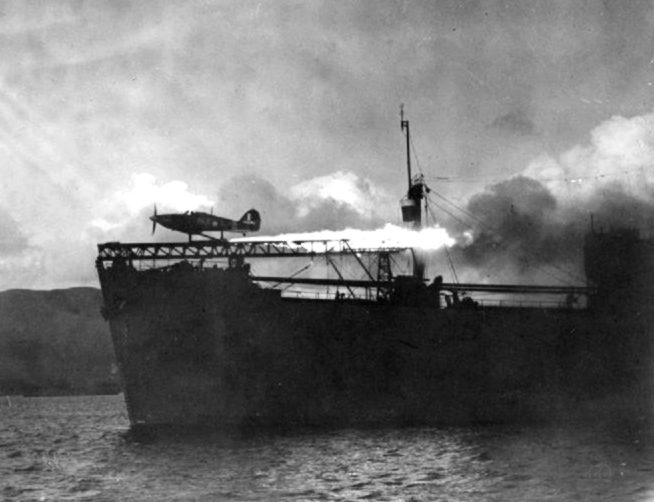
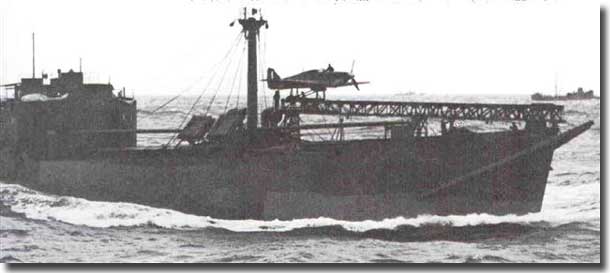
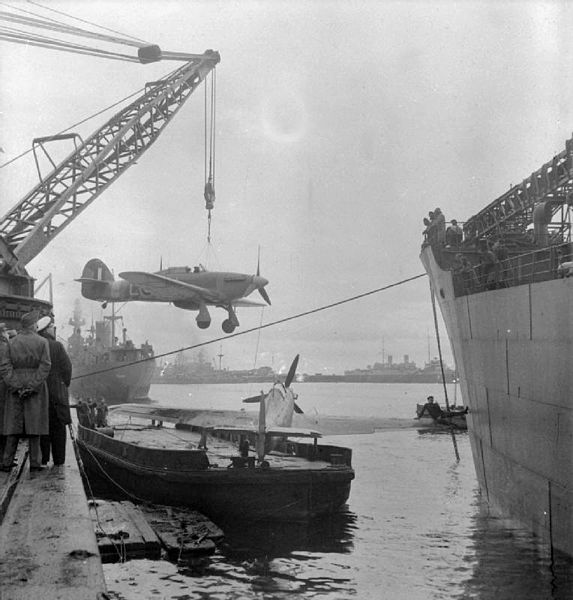
| The CAM ship Empire Lawrence |
The Germans first had suspects of an incoming convoy when, in early May, agents in Canada reported the gathering of shipping in Canadian harbours. It was estimated that the convoy would have reached Iceland to form up, leaving for Murmansk from the 17th onward. Confirmation of this suspects occured when the Fw 200 Condor units first sighted the British portion of the convoy on its way to Iceland, and then spotted the Distant Cover Force, correctly identifying the carrier and the battleships.
After reaching Iceland, the convoy sailed from Hvalfjord on 21 May. At this time of the year, the convoy would operate under particular conditions: due to the perpetual daylight of the Arctic summer, in fact, it was easier to spot and prevent U-boat attacks, but the daylight conditions also left the convoys more exposed to aerial detection and bombing.
The Luftwaffe planned several aerial reconnaisance sorties, but due to persistent banks of clouds and fogs, it was only on 25 May that PQ 16 was spotted by a FW-200, 120 miles east of Jan Mayen island. That same evening, the Luftwaffe mounted the first of a five-day series of attacks.
Units involved were KG 26 with its torpedo-armed Heinkel He 111s, and III./KG 30 with bomb-carrying Ju 88s. The Heinkels weren't successful, loosing one of their aircraft to a Hurricane launched by a CAM ship. The Ju-88 damaged one merchant vessel, the 5,127 ton Carlton, which was towed back to Iceland.
All attacks were repulsed on the 26th, but the 6,191 ton Syros was torpedoed and sunk by U-703. On 27 May, the air attacks began to break through: now southwest of Bear island, the convoy was attacked by several waves of German bombers, KG 30 alone mounting more than 100 sorties that day. First to be hit were the Russian Starshy Bolshevik and the ORP Garland, which were damaged but managed to stay afloat. The second wave of bombers hit the Alamar and the Mormacsul, 5,689 and 5.481 tons respectively, which both sank. The CAM ship Empire Lawrence was then hit by three Ju-88s, followed by a fourth in space of minutes, and sunk.
Other two ships were hit: the Empire Purcell (7,049 tons) blew up at around 20:00 hrs, while the City of Joliet was damaged and sank the following morning.
While the Junkers were wreaking havoc of the convoy, a gaggle of He 111s of KG 26 approached the vessels at low altitudes and sank the Lowther Castle with two torpedoes.
The following day, 28 May, the convoy was joined by three Soviet destroyers and four minesweepers, giving the amount of firepower needed to drove off subsequent attacks.
PQ 16 split up on the 29th, six ships heading for Archangel, while the rest of the convoy for Murmansk. The Ju 88s attacked again on the 30th, but this time they couldn't score any hits, and actually lost two of their numbers. According to John Weal, the Russian ace Boris Safonov (26 kills) scored at least one victory, before disappearing without trace.
After reaching Iceland, the convoy sailed from Hvalfjord on 21 May. At this time of the year, the convoy would operate under particular conditions: due to the perpetual daylight of the Arctic summer, in fact, it was easier to spot and prevent U-boat attacks, but the daylight conditions also left the convoys more exposed to aerial detection and bombing.
The Luftwaffe planned several aerial reconnaisance sorties, but due to persistent banks of clouds and fogs, it was only on 25 May that PQ 16 was spotted by a FW-200, 120 miles east of Jan Mayen island. That same evening, the Luftwaffe mounted the first of a five-day series of attacks.
Units involved were KG 26 with its torpedo-armed Heinkel He 111s, and III./KG 30 with bomb-carrying Ju 88s. The Heinkels weren't successful, loosing one of their aircraft to a Hurricane launched by a CAM ship. The Ju-88 damaged one merchant vessel, the 5,127 ton Carlton, which was towed back to Iceland.
All attacks were repulsed on the 26th, but the 6,191 ton Syros was torpedoed and sunk by U-703. On 27 May, the air attacks began to break through: now southwest of Bear island, the convoy was attacked by several waves of German bombers, KG 30 alone mounting more than 100 sorties that day. First to be hit were the Russian Starshy Bolshevik and the ORP Garland, which were damaged but managed to stay afloat. The second wave of bombers hit the Alamar and the Mormacsul, 5,689 and 5.481 tons respectively, which both sank. The CAM ship Empire Lawrence was then hit by three Ju-88s, followed by a fourth in space of minutes, and sunk.
Other two ships were hit: the Empire Purcell (7,049 tons) blew up at around 20:00 hrs, while the City of Joliet was damaged and sank the following morning.
While the Junkers were wreaking havoc of the convoy, a gaggle of He 111s of KG 26 approached the vessels at low altitudes and sank the Lowther Castle with two torpedoes.
 |
| Ju 88s of II./KG 30 photographed over Norway, 1943 |
The following day, 28 May, the convoy was joined by three Soviet destroyers and four minesweepers, giving the amount of firepower needed to drove off subsequent attacks.
PQ 16 split up on the 29th, six ships heading for Archangel, while the rest of the convoy for Murmansk. The Ju 88s attacked again on the 30th, but this time they couldn't score any hits, and actually lost two of their numbers. According to John Weal, the Russian ace Boris Safonov (26 kills) scored at least one victory, before disappearing without trace.
Further attacks were carried out after the convoy reached port. On 1 June KG 30 attacked the unloading merchants and dropped mines around Murmank, sinking the 5,685 ton Steel Worker.
In total, the Luftwaffe sank 8 ships, plus one damaged which was forced to turn home. The lost ships were:
- Alamar
- CAM Empire Lawrence
- Empire Purcell
- Mormacsul
- City of Joliet
- Lowther Castle
- Syros
- Steel Worker
The Lowther Castle was sunk by He 111s. The Spyros by U-703. All the other merchant vessels were sunk by bombs (or mines) launched by Ju 88s of KG 30.
In the book Luftwaffe anti-shipping units 1942-45, a Royan Navy report on German attacks can be found:
Bombing attacks: The Naval Authorities attributes the successes during the period of most intensive operations fom 11.15 to 21.30 hours on 27 May chiefly to the fact that the weather at the time was cluds but not completely overcast. The Junkers Ju 88 pressed home their attacks during this period to a much greater extent that when the sky was cloudless or completely overcast. The aircraft are reported to have dived at 60 degrees to a height of about 1000 feet before releasing their bombs of which they are reported to have carred four.
Torpedo attacks: The operations by torpedo-carrying aircraft do not appear to have been very successful. The aircraft approached flying low and released their torpedoes at about 10 feet. There is little information on ranges but it is known that the only hit obtained was the result of random shots from 400 yards and that, in general, the attacks were not pressed home.
CRITICAL SOURCES:
Chriss Goss, Luftwaffe anti-shipping units 1942-45, Luftwaffe Colours, 2006
John Weal, Junkers Ju 88 Kampfgeschwader on the Russian Front, Osprey Publishing, 2010
Chriss Goss, Luftwaffe anti-shipping units 1942-45, Luftwaffe Colours, 2006
John Weal, Junkers Ju 88 Kampfgeschwader on the Russian Front, Osprey Publishing, 2010
Tuesday, 8 November 2011
The Battle of Convoy PQ 15
Click here and subscribe to our RSSfeeds: http://feeds.feedburner.com/WorldWar2Eagles
After the invasion of the USSR in 1941, Winston Churchill decided to give the Russians all the help the British could guarantee, and therefore dedicated convoys were created to carry war material to the Soviet ports of Murmansk and Arkhangelsk. The conditions under which the warships and the merchants were to operate were very hard: summer and winter routes were dangerously close to enemy bases in occupied Norway, where U-boats, surface ships and aicraft were stationed and active. The winter months were characterized by appalling weather, extreme cold and low visibility. The summer months were instead charaterized by continual daylight of the Arctic summer, which made the ships extremely vulnerable to warships and bombers.
 |
| Winter and summer Arctic routes. Source: www.naval-history.net |
PQ 15 consisted of 25 merchant vessels, escorted by the Close Escort group led by Captain Harvey Crombie aboard HMS Bramble, together with two other mineweepers, four trawlers, four destroyers and the anti-aircraft ship HMS Ulster Queen.
The convoy was supported by two other groups: the Cruiser Cover force of Rear Admiral Burrough, with the cruisers HMS London, HMS Nigeria and two destroyers, and the Distant Cover Force led by Admiral John Tovey, which comprised the battleships HMS King George V and USS Washington, the aircraft carrier HMS Victorious, the heavy cruisers USS Tuscaloosa and Wichita, the light cruiser HMS Kenya and 10 destoyers.
The convoy sailed from Reykjavik, Iceland, on 26 April 1942. On 28 April, the Luftwaffe sighted the ships, approximately 250 nautical miles SW of Bear Island. Despite having being discovered, the convoy didn't meet any opposition for two days, as the attention of German air and sea forces was focused on the reciprocal convoy QP11, which was returning home from the Soviet Union. The inbound convoy was attacked by torpedo aircraft but none of the ships were hit.
In Commander Crombie's report, we come to know that, after crossing QP11, PQ 15 started being constantly shadowed, by BV 138 seaplanes and by the omnipresent Fw 200 Condors.
 |
| The bow of HMS King George V after colliding with HMS Punjabi |
Nothing happened until 1 May, when the Distant Cover Force was steaming surrounded by thick fog: in low visibility, HMS King George V and the destroyer HMS Punjabi collided: the latter, which had manouvred to avoid mines, was cut in two and sank with the loss of 49 seamen, while the battleships suffered heavy damage to her bow, being forced to return home.
On 2 May, in position 073° 01' N 017°32' E, HMS Seagull and the Norwegian cruiser St Albans obtained an ASDIC contact and carried out an attack on an enemy submarine. When the vessel was force to surface and fired, it was discovered that she was the Polish submarine Jastrzab (also cited as P551). Five crewmen had been killed (including the British liason officer) and six injured. The causes of the incident are, still today, a matter of controversy.
On 2 May at 23:37, in the half light of the Arctic summer night, the convoy was attacked in position 073° N 019°40' E by enemy torpedo bombers. They were six Heinkel He 111 of I./KG 26, which came in low on the starboard bow of the convoy. One of the Heinkels was hit and crashed in flames just ahead of the ships. The others passed through the protective screen and launched their torpedoes, passing low over the vessels. While leaving the scene, another Heinkel was badly hit and considered destroyed, although it was not seen crashing.
The attack was a success, as three ships were hit by torpedoes: SS Botavon, SS Jutland and SS Cape Corso: the latter blew up and rapidly sank, taking with her 50 of its 56 men (a partial casualty list is available here). Botavon settled down by her bows and was later sunk by gunfire from the escort ship HMS Badsworth. The escort vessel also picked up seamen from the Jutland, which was abandoned and then torpedoed and sank by U-251 at 00:14 hrs on 3 May.
The blow suffered by the convoy was heavy; three ships were lost with a considerable cost of lives and goods, and moreover the conditions of the Arctic summer night made the remaining merchant vessels exposed to more attacks. It was, in fact, difficult to see enemy aircraft, and the anti aircraft ship HMS Ulster Queen couldn't see the Heinkels as they had made their attack. This was highlighted in Captain Crombie's report:
 PQ 15 continued its course unmolested until 20:30 of 3 May, when enemy bombers where spotted. This time they were Ju 88s from KG 30. Two aircraft were seen, but more were heard above the merchants in the clouds, for an estimated six. The only vessel hit was the trawler Cape Palliser, who suffered minor damage from near misses. One of the Ju 88s was shot down.
The weather deteriorated and prevented the Germans to mount further air raids. The submarine threat was however still present: HMS Badsworth obtained a contact and dropped depth charges, reporting of having heard the submarine's blowing tanks, but nothing appeared on the surface and she couldn't confirm his kill. Two Russian destroyers joined the convoy at 10:24, 4 May. The weather worsened even more and a south east gale developped, bringing heavy snow. The appalling conditions provided excellent cover for the remaning part of the journey, and PQ 15 reach the Kola inlet at 22:00 on 5 May, without further losses. Of the 25 merchant vessels composing the convoy, 22 had safely reached their destination.
The entire operation was considerd a success, despite the difficult operational conditions. The long hours of daylight had exposed the convoy to air attacks, and the bad weather came as a relief for the vulnerable merchant vessels. It is interesting to note the the CAM ships didn't launched their Hurricanes, as it was intended to keep them for the final attack before the Kola inlet, where they could have landed on Russian soil.
Capitan Crombie wrote in his report:

On 2 May at 23:37, in the half light of the Arctic summer night, the convoy was attacked in position 073° N 019°40' E by enemy torpedo bombers. They were six Heinkel He 111 of I./KG 26, which came in low on the starboard bow of the convoy. One of the Heinkels was hit and crashed in flames just ahead of the ships. The others passed through the protective screen and launched their torpedoes, passing low over the vessels. While leaving the scene, another Heinkel was badly hit and considered destroyed, although it was not seen crashing.
 |
| Two views of SS Botavon |
The blow suffered by the convoy was heavy; three ships were lost with a considerable cost of lives and goods, and moreover the conditions of the Arctic summer night made the remaining merchant vessels exposed to more attacks. It was, in fact, difficult to see enemy aircraft, and the anti aircraft ship HMS Ulster Queen couldn't see the Heinkels as they had made their attack. This was highlighted in Captain Crombie's report:
The aircraft attacked in formation and it was disappointing that in spite of the fact that they came over and through the strongest part of the Screen of HM Ships Somali and Matchless it was not possible to break up the attack. [...]
The fact remains that HMS Bramble from the central position of the screen opened fire with her Oerlikon guns first, that if HM Ships Somali and Matchless had been a few seconds quicker on the trigger the attack might have been hampered a little and perhaps another aircraft brought down. But with the visibility prevailing, the lack of warning, the available gun power, and the resolution of the attack, I very much doubt whether loss of ships in the convoy could have been prevented. [Source: www.halcyon-class.co.uk]Before and during the attack from the air, it is possible that a U-boat shadowed and attacked PQ 15: signals were infact detected from the starboard bow of the convoy, and lookouts aboard HMS Leda saw a black shape disappearing when the aircraft attacked. HMS Somali was forced to alter course to avoid torpedoes, probably fired by that very same submarine. HMS Leda headed toward the black shape and dropped depth charges before loosing contact.

The weather deteriorated and prevented the Germans to mount further air raids. The submarine threat was however still present: HMS Badsworth obtained a contact and dropped depth charges, reporting of having heard the submarine's blowing tanks, but nothing appeared on the surface and she couldn't confirm his kill. Two Russian destroyers joined the convoy at 10:24, 4 May. The weather worsened even more and a south east gale developped, bringing heavy snow. The appalling conditions provided excellent cover for the remaning part of the journey, and PQ 15 reach the Kola inlet at 22:00 on 5 May, without further losses. Of the 25 merchant vessels composing the convoy, 22 had safely reached their destination.
The entire operation was considerd a success, despite the difficult operational conditions. The long hours of daylight had exposed the convoy to air attacks, and the bad weather came as a relief for the vulnerable merchant vessels. It is interesting to note the the CAM ships didn't launched their Hurricanes, as it was intended to keep them for the final attack before the Kola inlet, where they could have landed on Russian soil.
Capitan Crombie wrote in his report:
The very long hours of daylight make the task of the submarine difficult provided the screen is active and offensive and a successful attack should only be possible by an experienced and resolute submarine. [. . .]
Both bombing aircraft and submarine attacks will have their successes but it should be possible to keep them low. The defence of a large convoy against torpedo attack is, however, a different problem and constitutes a serious menace.Crombie finally gave credit to the excellent conduct of the merchant seamen:
I should like to record the excellent conduct of the convoy, the majority of which were American ships unused to convoy work. Their steadiness when the torpedo attack took place and leading ships, including the Commodore and Rear Commodore's ships were sunk, their speed of opening fire and their excellent station keeping made the task of the escorts very much easier. It was largely due to the good conduct and discipline of the convoy that twenty-two ships out of twenty-five arrive at Murmansk undamaged.

Subscribe to:
Posts (Atom)