Showing posts with label F4U Corsair. Show all posts

Thursday, 9 October 2014

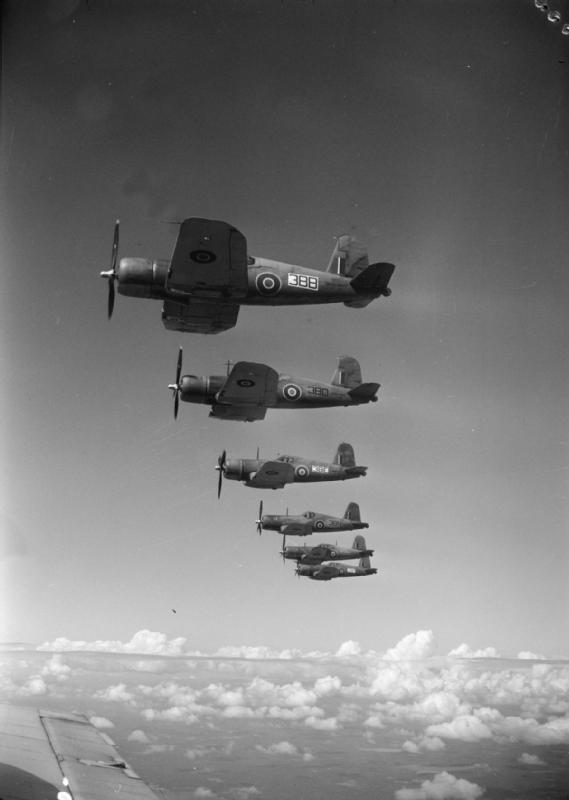
Royal Navy Corsairs

In 1939, the Fleet Air Arm entered the war with a considerable number of aicraft carriers, whose fighter squadrons were,  however, equipped with outclassed and obsolete fighters such as the Fairey Fulmar and Blackburn Roc.  

Naval versions of Hurricanes and Spitfire were soon developped to give naval aviators fighters able to match the enemy. Sea Hurricanes and Seafires possessed all the performance characteristics of their RAF equivalents, but they inevitably lacked the two most important features of a naval fighter - range and robust structure.
The aiframe could not cope with the rough deck landings, resulting in poor serviceability rates and lots of accidents. Their range was not adequate for over-water operations, even with the adoption of drop tanks.

The Royal Navy's only solution was the purchase of American fighters. They came in the shape of Martlets, Hellcats and especially Corsairs. The latter had been rejected by the US Navy for carrier operations - see article - but the Fleet Air Arm was determined to make it fully operational on its vessels. In June 1943, pilots from 1830, 1831, 1833 and 1833 Naval Air Squadrons were sent to the US for their Corsair training.

Familiarization with the Vought fighter was not easy, as it had been for US Navy pilots. The Corsair's high stalling speed, poor visibility and bouncing characteristics caused again many accidents. It was soon found out it was impossible to carry out a standard landing approach, flying abeam of the vessel in the opposite directions, turning perpendicular to the carrier's course and then turning again for the final approach. 

A new method was implemented, where the pilots were landing the Corsair in a stalling turn all the way to deck, thus improving their visibility. The fighter was flown just above stalling speed, judging the rate of descent so that by the time the deck had been reached, the throttle could be chopped and the aircraft would "drop" on it.

Thus the Corsair No. 1830, 1831, 1833 and 1834 NAS were declared operational on HMS Victorious and Illustrious, and many more squadron followed them.

Saturday, 30 August 2014

Corsair's troubled debut

What was to become one of the most important aircraft of the the 20th century actually had a very tricky and poor start.

On 9 January 1943, VF-12 was commissioned at San Diego under the command of Lt Cdr Joe Clifton. In the space of less than two weeks, the unit received twenty-two brand-new F4U-1 Corsairs and moved to Hawaii to practise carrier landings. VF-12 was the first operational unit flying the new Corsair fighter.

Despite its formidable features, the Corsair soon proved to a real nightmare for carrier operations. The Corsair was infact tricky to fly, with worrying stalling characteristics, poor visibility on landing and troublesome tail wheels, which often tended to blow out. 

Chance Vought engineers were working closely with VF-12 to fix the Corsair's defects: battery installation and flaps had to be modified, shotgun starters had to be replaced by electric ones and new tail wheels had to be designed. 

During its time operating the Corsair, VF-12 lost seven pilots, and several more aircraft had to be written off. All these incidents soon gave the F4U a nickname - "The Hog".
One of many landing accidents aboard USS Charger

Resulting from all these carrier landing misfortunes, VF-12 had to relinquish its Corsairs. By the time the unit sailed onboard USS Saratoga in July 1943 for its first combat duty, the F4U had been replaced by the Grumman F6F Hellcat.

The second unit to receive the Corsair was VF-17, which commenced training in Norfolk, Virginia, in February 1943. The squadron was commanded by Lt Cdr John T. Blackburn, who had previously led a fighter squadron during Operation Torch, the invasion of North Africa in 1942.
Blackburn's pilots were little experienced but highly motivated and aggressive as they took every opportunity to fly low-level both over land and sea, skimming the waves, flat hatting trucks one the roads and very often flying under bridges. Future ace Ira Kepford even engaged in a dogfight with an Army P-51 over Norfolk.
All these exploits soon earned VF-17 the nickname "Blackburn's Irregulars".

In March 1943 the squadron moved to North Carolina to complete its pre-carrier training. The pilots worked hard to tame the wild Corsair and managed to fix many of the fighter's early defects. They improved landing characteristics by creating a new anti-stall wing device, and increased visibility with the simple expedient of sitting on two or three parachute cushions.

On 1 May, Blackburn made the first carrier landing, on a simulated carrier landing area marked off a runway. He and his pilots soon followed practising on the converted merchantmen Charger, in the Chesapeake Bay. Despite the difficulties, VF-17's pilots mastered the landing, even though at least six pilots were lost.

On 23 May the unit flew to Boston for its commissioning onto USS Bunker Hill. En route, CO Blackburn took its squadron over New York, where all of its twenty-five Corsairs drop down and flew under the Brooklyn Bridge.

VF-17 set sail aboard USS Bunker Hill for her shakedown cruise in the Caribbean. The squadron kept practising carrier landing together with other new types, such as the SB2C Helldivers.
Results were not encouraging; landing the Corsair was, in fact, very difficult due to the long nose which compromised visibility. Opening the engine's cowl flaps meant cutting down visibility virtually to a zero, but the pilot had no other choice, since leaving them opened caused to engine to overheat.
Arrestor hooks also caused serious problems, as they were simply snapped when coming into contact the steel arresting wires.
The shakedown cruise taught important lessons to VF-17 pilots and Chance Vought; by the end of August, thirty-six new F4U-1As were delivered to the squadron. They featured  new arrestor hooks, raised cockpits which increased visibility and new propellers.

Despite Blackburn's men efforts, they Navy would however decided that the Corsair was "too hot" for carrier operations, and refused to give VF-17 carrier qualification. When USS Bunker Hill returned to Pearl Harbour in October 1943, all its Corsairs were flown ashore.
The squadron was given a choice. They could stay onboard the aircraft carrier and fly F6Fs if they wanted, or wait transportation to the Solomons to operate as a land-based fighter unit. All but one of VF-17 pilots decided to stick to their beloved Corsairs.