Showing posts with label Nachtjagd. Show all posts

Saturday, 31 January 2015

Nightfighters in the East: new units

UNDER CONSTRUCTION

During the spring and summer of 1942, the increasing number of Soviet night raids had found an effective response from the fighters of JG 54. However, the Geschwader was soon called to switch priorities and support the ground forces in the second summer offensive on the Eastern front

Enemy raids however did not stop: Red Air Force bombers continued to harass German lines of communication at night, as well as dropping thousands of partisans in occupied areas. To find a solution to these problems, Wolfgang Falck was sent on an inspection tour in Russia in the summer of 1942. At the conclusion of its tour, he recommended the use of local Luftwaffe resources to mount night fighter patrols along the front.

Falck considered impossible the transfer of any of the existing Nachtjagd units to the East. Bomber Command operations over Germany were in fact escalating and all nightfighter squadrons were hard pressed countering the British bombers. Therefore, he advised making good use of those bomber, zerstorer and reconnaissance pilots who were proficient in blind flying to face the night raids.
The concept was quickly accepted by senior Luftwaffe leaders, and those pilots selected for the role were sent to Wiener-Neustadt to receive further specialised training.

Operations officially commenced in October 1942, but soon the events on the ground dictated a rapid switch in priorities. The Sixth Army was completely surrounded by the end of November, and the newly trained nightfighter units had to divert their duties flying ground attack missions around the Stalingrad pocket, until the Sixth Army surrendered on 5 February 1943.

After a brief respite to recover from the heavy losses sustained, the Nachtjager pilots started exacting a steady toll of Soviet bombers. First to score was Josef Kociok of 10(N)./ZG 1, who claimed two bombers on the night of 12/13 March. Kociok's victories were followed by another future ace's kill: in the night of 15-16 March, Oblt Gunter Bertram scored his first victory.
Leutnant Josef Kociok, KIA 26 September 1943

Posted at NJS (Nacthjagdschule) of Luftflotte 6, Bertram was an experienced pilot, most probably an instructor with the unit, although no sources are available to confirm it. Bertram quickly established himself as a successful hunter, reaching 12 kills in June, less than three months after his first claim.

In the meantime, IV./NJG 5, under the command Hptm Prinz zu Sayn Wittgentstein, moved to the Eastern Front in February. Already an Experte with 22 victories, Wittgenstein quickly found ideal conditions in the east, where there was no electronic/radio jamming and Soviet bombers were less perfomant then their RAF counterparts. The young aristocrat scored two "doubles" on 16-17 and 22-23 April, followed a fifth success on 2-3 May.
The Gruppe was unexpectedly recalled to the Western front for less than two months and then again sent to the East in July, for the forthcoming operations in the Kursk salient.
Once again, Wittgenstein led its unit by example, achieving multiple kills on many sorties, with the exploit of 20-21 July when seven bombers fell under his guns. On 9 August 1943, a DB-3 marked his 60th victory. Wittgenstein was called back to Germany and IV./NJG 5 redesignated I./NJG 100, thus becoming permanently assigned to the Eastern Front.

The other two already mentioned Experten, Kociok and Bertram continued scoring steadily against the Red Air Force, and were occasionally joined my more pilots. Oblt Landau of 10./NJG 5 scored a treble on 16-17 July, while Hptm Lechner added three victories to its Western account reaching 14 on 29-30 July.

The success of these pilots and units did not prevent, however, the Red Army from halting the Wermacht attack at Kursk, thus marking an end to any German offensive operation on the Eastern Front. From that moment until the end of the war, the Luftwaffe and the Wermacht were forced to operate defensively, having lost any strategic edge against the enemy.


Friday, 16 January 2015

Nightfighters in the East: the Beginning

On 21 June 1941, the Wermacht launched Operation Barbarossa, the invasion of the Soviet Union. The bulk of the Luftwaffe was committed to the invasion and achieved spectacular successes in the first days of the attack, destroying thousands of Soviet aircraft in the air and on the ground.  The tasks assigned to fighter, bomber and ground attack units were essentially tactics: destruction of enemy airfield, lines of communication, supply depots and enemy strongholds. Barbarossa can be considered as the ultimate Blitzkrieg, with the aviation acting as flying artillery for ground forces.

The Luftwaffe had therefore conceived its plans from a tactical point of view: for this reason, no night fighting units had been sent to the Eastern Front, since the threat of night bombing was not considered effective as it was on the Western Front. The Soviet Air Force, however, began almost immediately to mount night operations against the advancing Germans and even attacked Berlin. If the Luftwaffe air superiority was almost undisputed by day, there was not any organized form of night air defense to counter Russian raids.

Luftwaffe units had to improvise, utilizing at the best the longer daylight hours of the summer, flying patrols at sunrise and sunset on known targets. The first kill came on the night of 25-26, when Ogfr Josef Kociok shot down an SB-2. Although it would have taken him long to score more kills after his first victory, he was to become one of the most successful night fighter pilots on the Eastern Front.
Bf 109 G-2 of 9./JG 54 at Krasnogvardeisk in 1942

The second victory was scored on 20-21 October 1941, when an Il-4 was destroyed by Lt Rudolf Altendorf over Berlin. After Altendorf’s victory, the long and harsh Russian winter prevented fighter units from scoring any other night kills. The Luftwaffe was in fact caught totally unprepared for severe cold weather operations: its units struggled for the whole winter period to keep decent serviceability rates by day, with night sorties becoming almost impossible. The following summer, however, a few pilots from JG 54 were to achieve great success against Russian night intruders.

By the summer of 1942, JG 54 was the highest scoring unit of the Jagdwaffe. Operating in the northern sector, the Geschwader experienced ever increasing enemy activity at night. To counter such raids, pilot from III. Gruppe decided to take advantage of the longer summer daylight conditions, mounting patrols at dusk and noon. They were soon rewarded with significant results. On  the night between 7-8 June, 1942, two pilots from 8./JG 54 shot down 6 enemy aircraft: Oblt Gunther Fink destroyed four R-5 bombers, while Lt Hans-Joachim Heyer took other two of the same type.
Hptm Gunther Fink (1918-1943)
The same two pilots scored five more victories on the night of 10-11 June, four aircraft for Fink and one for Heyer. Again on the following night, 11-12 June, they scored one kill each, and they were joined by Hptm Reinhard Seiler who scored twice and Oblt Werner Feise with one. Their victims were SB-2s and R-5s.
III./ JG 54 continued to its exploits over the following night: on 14-15 June Reinhard Seiler destroyed two R-5, Gunther Fink one PS-84 (Li-2), while Erwin Leykauf and Waldemar Wubke got one R-5 each. The following night Seiler scored four more kills against Soviet intruders, and Heyer scored two on the night of 17-18 June.
Oltb Erwin Leykauf

After a few days of apparent calm, night sorties flared up again and the Gruppe had a field night on 22-23 June, destroying 8 enemy aircraft. Two of them were shot down by Reinhard Seiler, and six by Erwin Leykauf. One solitary kill was scored by Oblt Gunther Fink on 24-25 June, followed by six victories on 25-26 June: three of them for Seiler and one each for Leykauf, Werner Feise and Wolfgang Kretschmer, the latter achieving his first victory.


Reinhard Seiler’s last night kills were achieved with a double on the night of 27-28 June. After that date, JG 54 priorities shifted drastically. The entire geschwader was infact heavily committed on daylight operations, supporting the Wermacht for the 1942 summer offensive. Despite that, two pilots managed to achieve their first night kills. Hptm Karl Sattig destroyed to U-2 on the night of 5 July, and Hptm Joachim Wandel shot down seven enemy aircraft on 7-8 July, a single one on 8-9 July, two more on 19-20 July, ending its night exploits with three U-2s shot down on the night of 2-3 August 1942.


Friday, 19 December 2014

Fernachtjager - Long range night aces of the Luftwaffe


In the late summer of 1940, when the bulk of the Luftwaffe was engaged in the fierce battles over Britain, the newly formed Nachtjagd was experiencing frustrating times against Bomber Command's night raids over Germany. Radar technology was still in its embryonic phase, thus intercepting bombers at night was an extremely difficult task and results were disappointing.

To address the problem, it was decided to send night fighters in offensive sorties over Britain. The unit chosen for the task was the Zerstorer Staffel of KG 30, equipped with Junkers Ju 88C long range fighters. The staffel was redesignated I./NJG 2 and moved to Gilze-Rijen in the Netherlands.

It had been originally planned to attack the enemy bombers as they took off from their bases and along their approaching routes over the North Sea. However, no radars had enough range yet to monitor the British mainland, and the fighters did not have any airborne radar sets, thus rendering interception over the North Sea impossible.

The only viable method was to infiltrate the bomber stream on its way back to England, attacking bombers when they where flying with their navigation lights on their landing approach.

The first victory came on the night of 20-21 October, when Hptm Karl Hulschoff destroyed a Hereford near Dishforth (the Hereford was the Napier Dagger-powered version of the Handley Page Hampden).
A few nights later, 24-25th, Lt Kurt Hermann scored two kills against Blenheims and Lt Hans Hahn a third one against a Wellington. A further kill came before the end of the month, when Lt Heinz Volker destroyed a Hampden over the Lincolshire coast.

The month of November and December saw the Gruppe scoring other kills over England. Hahn and Herman increased their tallies and started gaining a reputation as long range intruders, together with Heinz Struning who scored his first victory on 23-24 November; he was to become one of the leading night fighter pilots of the Luftwaffe.
Hans Hahn

The new year started with four victories in the first four days, scored by Lt Rudolf Stradner, Uffz Helmut Arnold, Hans Hahn and Lt Gerhard Bohme respectively. Bad weather prevented the units from achieving more success, and the only two other kills were scored by Oblt Albert Schultz on the night of 15-16 January.

The following month started the beginning of six months of greater success for I./NJG 2. Twelve kills were scored in the month of February alone, with leading aces such as Hermann and Struning increasing their scores, while Oblt Paul Semrau opened its account.
The night of 10-11 February was particularly successful, when seven kills were scored against British bombers.
If March was a relatively quiet month with only 8 victories - two of them for Hans Hahn-, April was the month when the Fernacthjager became the nightmare of RAF defences. I./NJG 2 scored 25 victories and severely disrupted Bomber Command operations over Eastern England.
Hans Hahn increased its score to 8 kills, Heinz Volker to 7, and future ace Wilhelm Beier scored his first two kills.
The final exploit came on the night of 29-30 April, when Ofw. Hermann Sommer shot down three Blenheims and a Beaufort, plus five other aircraft on the ground.
Heinz Struning

In addition to their air-to-air kills, the Gruppe's Junkers Ju 88 were also attacking ground targets, dropping fragmentation bombs on enemy airfields and strafing parked aircraft. The amount of disruption was so severe that the RAF suspended all night training operations over Eastern England and the psychological effect on Bomber Command's was also very heavy.

From May to August 1941, I/NJG 2 scored steadily, achieving 13 victories in May, 21 in June , 19 in July and 15 in August.
Hans Hahn opened the streak downing a Stirling on 2-3 May and then shooting down a Fulmar and a Blenheim on the following nights.
Heinz Struning and Wilhelm Beier achieved acedom on 9-10 May and 3-4 June respectively. Another Fernachjager who rose to fame was Paul Semrau, who scored 4 four victories in May and June.

The months of July and August were to be final swan song for the Gruppe.

Wilhelm Beier scored multiple kills in  the nights of 5-6, 6-7, 17-18 July and 7-8 August, reaching 14 confirmed victories. Feldwebel Alfons Koster started achieving fame in July, reaching 5 kills on 14-15 July and increasing his tally to 11 within October.
Wilhelm Beier

Hans Hahn, the leading Fernachtjager ace, was awarded the Knight's Cross on 9 July as the first pilot to score 10 victories at night,  and went on shooting down two more enemy bombers, before finally meeting his fate on the night of 12-13 October. The German ace attacked an Airspeed Oxford on a training flight near Grantham, but the two aircraft collided and both crashed.

The death of Hahn marked the end of I./NJG 2's experience an night intruders over Britain, as in the following the days the Gruppe was withdrawn from Channel operations and sent to the Mediterranean theatre, supporting Afrika Korps operations in North Africa and against Malta.

Tuesday, 17 July 2012

Essential History of the Nachtjagd - Reorganization and electronic warfare


At the end of 1942 the Nachtjagd consisted of 7 Gruppen, for a total of around 360 machines, although no more  260 were serviceable at the same time. Despite this increase in pure numbers, Josef Kammhuber and its men of the XII Fliegerkorps were deeply worried for the future. The Messeschmitt Bf 110, the main nightfighter of the Luftwaffe, had received low production priority by the OKL, and was subsequently produced in very low numbers, with an incredibile negative peak of 0 machines produced in January 1942. Only in March of the same year the Bf 110 was given a higher priority and production could recommence.

The aircraft intended to replace the Bf 110 was the Me 210, which proved to be a complete failure and had to be rebuilt in the new Me 410. Of the other aicraft in service with the Nachtjagd, the Ju 88C had given the best results, especially when used as a long-range intruder over England. Again, the number of Ju 88C in service was rather small, as factory priority was given to bomber versions of the Junkers. The third, and final, twin-engined night fighter pressed into action was the Dornier Do 217J, which had however poor manoeuvrability and low speed.
Bf 110 F-2 of 7./NJG 4

During the summer of 1942 the Nacht Gruppen received their first Bf 110F-4 and Ju 88C-6 fighters. These two models where the first specifically intended for the nightfighting role, and therefore represented the backone of the Nachtjagd for the two following years.
The tactical situation for the Germans was nevertheless not optimistic, as the British had realized how to cope with the Himmelbett system: in fact, after passing the radar belt, the bombers had almost nothing to fear, especially over Northern and Eastern Germany. Many vital industrial cities such as Rostock, Hannover, Magdeburg and Frankfurt were defended by no more than Flak units.
The situation was at the same time bad for the Bomber Command: post-mission analysis and research had shown that just 10% of the bombers used to drop their bombload "within" the target - "within" meaning anyway 8 km around it. In addition to that, just 25% of the pilots who claimed to have bombed their assigned target had actually reached and indentified it correctly.
This poor results demanded for change, and change came in the form the new Air Marshall Arhur Harris. Harris was an advocate of strategic bombing, and immediately put this theory in to practice, identifying German cities and town as the new main targets. His aim was related to air power theories of the 30s, focusing on to destroying cities and undermining civilian morale. As it had failed in 1940 during the Battle of Britain, it would have failed again for both the British and the American's strategic campaigns.

The night of 29 March 1942 saw the first RAF raid against a metropolitan target. 191 bombers attacked the medieval city of Lubeck, loosing 12 of their numbers (5%). The attack created a firestorm, which caused severe damage to the historic centre of the town and destroyed three churches. A second attack on the medieval town of Rostock, prompted Hitler to unleash the Baedecker Raids against England , which targeted Britain's cities of historical and cultural interest. It easy to see how both German and British historic cities were no militarly valuable target, so this raids were senseless in terms of losses sustained and destruction caused.

In early May 1942 the Nacthjagd was once again reorganized: the old 1. Nachtjagddivision was divided into 1., 2. and 3. Jagddivision, each one with its assigned area of operation. This important change meant that the Nachtjagdgeschwader opeated each one in a specific Himmelbett box, thus increasing combat experience and  serviceability of the crews and machines.
On 31 May, the Bomber Command carried out its first 1,000-aircraft raid, attacking Cologne. The 1,042 bombers adopted a new tactic. Instead of flying separate routes towards the target, thus touching all the Himmelbett boxes, they flew in a concentrated stream wide less than 30 km, reaching no more than 8 night interception areas. Just 44 bombers were shot down, dramatically demonstrating how the Himmelbett system was incapable of coping with mass attacks.

Despite all these difficulties, between April and June 1942 the Nacthjagd scores 230 victories, reaching its 1000th kill in September. Experten started to rise among the Nacht Gruppen, especially those who already had blind flying experience such as former bomber or reconoissance pilots.
Between May 1941 and December 1942, Helmut  Lent scored 48 night victories
The summer of 1942 also saw the birth of "electronic warfare". Six months earlier, in March, the Bomber Command had created the Pathfinder Force, whose aim was to reach the target marking it with flares, allowing the Main Force to bomb it succesfully. In order to do so, Pathfinder bombers were equipped with the Gee, a hiperbolic radio navigation system. During the 10 August-raid on Osnabruck, Pathfinders crews found out the their Gees couldn't guide them on their target. They had been jammed by the Heinrich, which was so successful that in a few weeks the RAF was force to abandon the Gee, and to developp its successor, the Oboe. This new improved navigation system was used for the first time on 20 December and was immune to jamming. In addition, the bombers started to be fitted with the Tinsel, which was able to interfer and jam R/T transmission between fighter pilots and ground controllers.

Essential History of the Nachtjagd - The early days and the Himmelbett


The history of the nachtjad begins in late 1939-early 1940, when the Bomber Command, frustrated by the severe losses sustained during daylight raids over Germany, decided to divert its aircraft to night operations. At that time, the Luftwaffe had operational three Staffeln for night fighting duties :
  • 10. (Nacht)/JG 26
  • 10. (Nacht)/ZG 26
  • 10.(Nacht)/JG 53.
This unit were tasked with defending the Reich airspace collaborating with searchlights and flak batteries on the ground. Given the nature of the job, victories were rare, while losses for flying accidents were extremely high. Also, the Luftwaffe was not particularly interested in night interception, as the Wermacht was on the offensive and the danger of night bombing was considered minimal. In december 1939 the two night staffeln of JG 26 and ZG 26 were joined into a single unit,  with the add of 11.(Nacht)/LG 2. This led to the creation of the first night Gruppe, designated IV(Nacht)/JG 2.

Victories continued to be rare: between April and May 1940 three kills were recorded, but they were actually scored at dusk or dawn, rather than night. On 17 July, 1940, it was decided to create the 1. Nachtdivision, under the command of Major Josef Kammubher, former Geschwaderkommodore of KG 51. With Kammubher's leaderships, the organization of night flying units was entirely revolutionized, and at the end of 1940 it is so composed:
  • I., II. II/NJG 1 equipped with Bf-110 C-1
  • 10./NJG 1 equipped with Bf 109D
  • 1. and 2./NJG equipped with Ju-88C, Do 17Z and Bf 110C
The main difficulty for night pilots was to catch and attack the enemy in total darkness, therefore Kammhuber and General Wolfgang Martini set up "enlighted" sectors, were searchlights on the ground operated in order to illuminate specific areas of the sky. In addition, they ordered development and implementation of radar installation, especially the FuMG62 Wurzburg and the FuMG80 Freya.

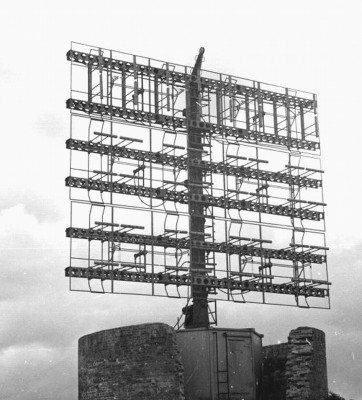
Freya  radar antenna

Interception were still entirely handled by the pilots in the air: ground control was still not available, so what the pilots could do was to wait near the illuminated ares, hoping to spot a bomber silhouetted against the sky, giving full speed and trying to attack before the target disappeared into the darkness. Soon the British realized the it was sufficient to avoid the searchlight belts to escape interception, therefore Luftwaffe victories redscended to the minimum. The system, known as Helle Nacthjagd (illuminated nightfighting) became clearly ineffective. Kammuhuber's reaction led to creation of the Dunkle Nachtjagd (dark nightfighting), where the fighter where assisted by Ground Control (GCI), placed behind the searchlight belts and based on Freya and Wurzburg radars.

Around the most important cities, the "dark" and "enlighted" methods were combined into the Konaja (Kombinierte Nachtjagd, combine nightfighting), which operated in close contact with Flak units on the ground. At the end of 1941 the 1. Nachtdivision was renamed XII FLiegerkorps. Its units were almost entirely equipped with the Messerchmitt Bf 110. The exception was represented by I./NJG 2, which operated Ju 88C and Do 17Z in long-range offensive mission, known as "Ferne nachtjagd" (ferne meaning far). These missions proved to be extremely costly in terms of losses, but were also highly successful, both in terms of bombers shot down and diverted British resources.

The pilots of I./NJG 2 used to follow Bomber Command bombers on their way back home, waiting until they reached their airfields and attacking them at the most vulnerable moment, while landing or circuiting. The Germans also dropped bombs on the airfields, creating chaos and confusion, as the gunners on the ground  couldn't fire back fearing to hit their fellow bombers. The unit scored  141 confirmed victories, and also forced the RAF to stop night flying training in East Anglia, Lincolnshire and Yorkshire. At the end of the year, however, the units was transferred to North Africa, to mount long range missions against Malta.


The end of 1941 also saw the introduction of the Himmelbett interception system. It consisted of a series of radar stations, organized in a continuos belt running from central France to Denmark. Each radar covered an area of about 32 km long (N-S) and 20 km wide (E-W). This areas were known as boxes, and operated with a complex mechanism of electronic devices and searchlights. A Freya radar with a 100-km range was used to pick up targets on their way to the Reich, assistes by a Wurzburg radar who gave indication of speed and altitude of the incoming bombers. A second Wurzburg was manned by ground controllers to vector the fighter within 3-400 m from the target. There was also a "master searchlight" directed by the first Wurzburg, supported by a number of manually directed searchlights. Each box had is own assigned night fighter, with one backup.
It was a complex and elaborated method which had its own advantages and drawbacks. Since British bombers used to fly indipendent routes towards their targets, it was theoretically possibile to intercept every single bomber. Once the Freya and Wurzburg radars had determined speed and altitude, the searchlights illuminated the plane: at the same time, ground controllers gave the pilots instruction to intercept the bomber. Once reached 3-400 m, the night crews were on their own and attacked by visual means.
The pitfalls on this method were clear from the very moment it was implemented. It required a huge amount of resources, because each box had at least three radars, one GCI control station, a number of searchlights and limited time to conclude the interception. In fact, GCI on the ground could only intercept a bomber within their own boxes.
In addition to that, the pilots were still blind on the air, relying entirely on the instrucionts from the ground. This meant that chances of successful interception depended on the experience and skill of the ground controller.
The Luftwaffe tried to give night pilots their own "night eyes" by mounting aboard Do 17Z the "Spanner Anlage", an infrared device which gave poor results.
9./NJG 1, Schleswig, 1941

The solution came in the form of the FuG 202 Liechtenstein B/C radar, which had a minimun range of 200 m and a maximum of 3-4 km. Once the GCI had vectored the fighter in the proximity of the bomber, the crews could pick it on their radar and chase it on their own.
Pilots were initially reclutant to mount to heavy radar antennas on their planes, but they changed their mind when victories started to rise. However, it took almost a full year before the Liechtenstein B/C could be distributed to all Gruppen, as the conversion center of Diepensee had a capability of just 5-6 aircraft per week.